


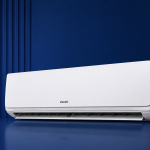
You may have heard the term ducted split along with wall-mounted air conditioners. Both of these devices are members of the ventilation system family and their job is to cool the environment. But what are the features of each of these devices and what is the main difference between a ducted split and a gas air conditioner?
In this article, we will examine the differences between ducted split and gas air conditioners and examine the strengths and weaknesses of each to help you make the best choice for your needs. First of all, we need to introduce each of these systems.
What is a split duct?
Duct splits were generally used in stores, office centers, hotels, and large spaces in the past, but today they are also used in homes. These devices have a central system that is responsible for the cooling operation.
Finally, by sending this cold air to the duct splits in each room, they create a uniform temperature in all rooms. Overall, the duct split is responsible for creating a uniform temperature in a large space.
Split duct It has the ability to produce cooling and heating. Some of them have a Wi-Fi kit and can be controlled by a mobile phone.
What is a wall-mounted air conditioner?
Air conditioner, often called Wall-mounted split It is known to consist of two main parts: an indoor unit and an outdoor unit. This system is designed for cooling and heating. It is easy to install and is commonly used in homes, offices, and shops.
Advantages and disadvantages of duct split
Advantages of duct split:
Possibility of injecting fresh air outside the building
Balanced distribution of hot and cold air
Possibility of using one central device in the unit instead of several air conditioners
Possibility of channeling to different spaces
Disadvantages of split ducts:
It is not possible to manually adjust the air temperature in each room and location independently.
Energy is wasted because some areas that do not need ventilation are ventilated.
Although Zanti ducted splits use very low-noise fans, these systems may produce more noise than wall-mounted air conditioners due to the use of fans.
More difficult to install due to the need for design and installation during building construction
Advantages and disadvantages of wall-mounted air conditioners
Advantages of wall-mounted air conditioners:
Ability to adjust the temperature of each room independently
No energy waste in environments that do not require ventilation
Low sound of the indoor unit
Easier installation
Disadvantages of wall-mounted air conditioners:
Inability to adjust temperature in large environments
occupying space on the wall

7 differences between a ducted split and a wall-mounted air conditioner
1. Heating or cooling power and capacity
Power is actually the winning card of a ducted split compared to a gas air conditioner, and in general, the coverage power of a ducted split is many times that of a wall-mounted gas air conditioner.
In fact, the heating and cooling capacity of a wall-mounted air conditioner is more suitable for a small room or hall.
2. Beauty
Another difference between the two is aesthetics. The indoor unit of a wall-mounted air conditioner is installed in plain sight, while the outdoor unit must be placed in an open space.
In contrast, a split duct is installed inside the false ceiling and is not visible to the public. This feature can contribute to the beauty of the building.
3. Structure and installation
Wall-mounted air conditioners have a simple structure and consist of an indoor unit and an outdoor unit. These systems are relatively easy to install and usually require little space.
These types of coolers are more suitable for small and medium spaces, and if they need to be used in multiple rooms, they must be installed separately for each room.
Duct splits are central systems that consist of an indoor unit, an outdoor unit, and air distribution ducts. The installation of these systems requires specific infrastructure and is usually implemented in buildings under construction.
These systems are hidden in appearance, with only the air outlet vents visible inside the space.
4. Air distribution
One of the main advantages of a ducted split is the ability to distribute conditioned air to multiple locations. The ducts send cool or warm air to all rooms and spaces in the building.
This system creates uniform, comfortable air throughout the building and eliminates the need to install multiple separate devices.
5. Energy consumption
Wall-mounted air conditioners operate individually, and if multiple units need to be installed in a building, energy consumption and installation costs increase. Also, their performance may be limited in large spaces and multiple units may need to be installed.
Energy consumption in ducted splits is usually lower than in gas air conditioners. This is due to the high efficiency of the indoor unit, which distributes air to multiple spaces simultaneously, while in wall-mounted air conditioners, each unit operates independently.
6. Temperature regulation and control
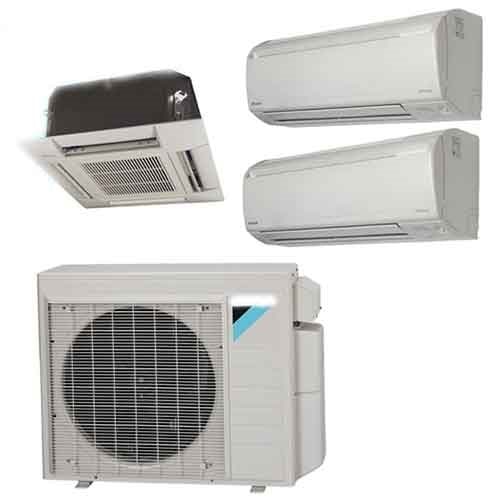
In gas air conditioners, there is an independent system and temperature adjustment is easy. Because there is an evaporator in each room and a condenser for each evaporator. This means that you are easily able to control the temperature of each using the device's control unit.
But on the contrary, in a ducted split system, all rooms are connected to an evaporator by ductwork, and we cannot have separate temperature control for each room or independent space.
7. Volume
The noise of a ducted split evaporator is much louder than that of a gas air conditioner due to the larger fan dimensions, as ducted splits are designed to produce large volumes of air and have a more powerful motor.
The amount of noise produced by ducted split units is so loud that we cannot use them indoors.
final word
The choice between a ducted split and gas air conditioner depends on the specific needs of each space, budget, energy consumption, overall building structure, and installation capabilities.
While gas air conditioners are more suitable for small spaces, ducted splits are a more efficient and economical option for large buildings and complexes.